
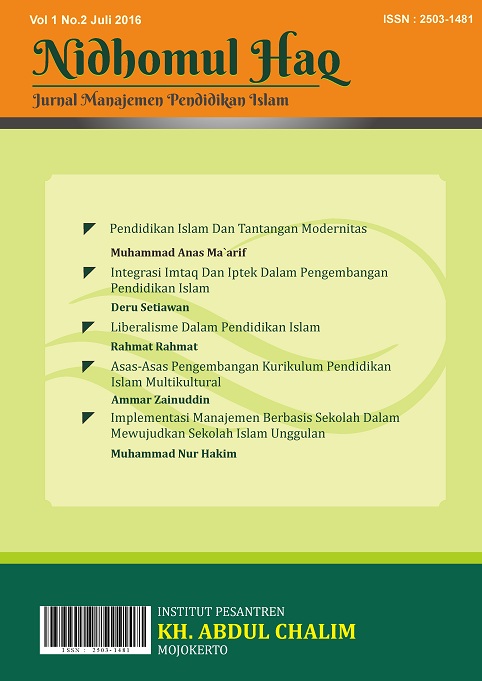
Implementasi Manajemen Berbasis Sekolah Dalam Mewujudkan Sekolah Islam Unggulan
Abstract
School-based management is implemented so that it can give ease in achieving the vision, mission, and goals of the institution, so that it can improve the quality of education and bring a good end result and quality, and can get a productive and qualified graduates. This research was conducted in SMP Ar-Rohmah and SMP Plus Al-Kauthar Malang, where the school is the educational institution that has a future orientation. The institutions including educational institutions featured with learners who are full of achievement in terms of both academic and non-academic. This study focused on four issues, are: 1) The factors that encourage the implementation of MBS; 2) The principles of what is done in the implementation of MBS; 3) What is the purpose of implementation of MBS; and 4) How does the structural components MBS implementation.This study used qualitative methods, multi-sites. data collection used the interview, observation and documentation. The research findings were: 1) the factors that encourage the implementation of MBS is: (a) the existence of decentralization; (b) a factor of independence against a school owned resources; (c) factors initiative; and (d) a factor of innovation against the increase in the quality of education. Then the purpose of the implementation of the MBS, namely: (a) so that the school could improve the quality of education by making the school more independent, have awareness/participation, teamwork, initiative and school in managing, utilizing, and empower the resources available; (b) the school can be more generous in taking decisions together and initiate and innovate in the process of improving the quality of education. 2) Then there are structural components of the MBS implementation, namely: (a) the management of curriculum and instructional programs; (b) the management of produce educators in schools; (c) the student Management; (d) financial management and financing; (e) management of educational facilities and infrastructure; (f) management the management of the school and community relations; (g) the management of special service institution that is effective and efficient.
Downloads
References
Kuncoro, Gatot. “Peran Kepala Sekolah Dalam Implementasi MBS di MTS Negeri Piyungan Yogyakarta”, Tesis MA, (Yogyakarta: UIN, 2008)
Darodjat, “Pola Implementasi MBS di MAN 3 Malang Jawa Timur”, Tesis MA, (Yogyakarta: UIN, 2004)
Dally, Dadang. Balanced Score Card, Suatu Pendekatan Dalam Implementasi MBS, (Bandung: Remaja Rosdakarya, 2010)
Danim, Sudarwan, Visi Baru Manajemen Sekolah, (Jakarta: PT. Bumi Aksara, 2008), cet. ke-3.
Depdiknas, Manajeman Peningkatan Mutu Berbasis Sekolah (Jakarta: Depdiknas, 2000)
Departemen Agama RI, Desain Pengembangan Madrasah (Jakarta: Direktorat Jenderal Kelembagaan Agama Islam, 2004)
Fattah, Nanang, Ekonomi dan Pembiayaan Pendidikan, (Bandung: PT. Remaja Rosda Karya, 2002) Cet. Ke-2.
Ghony, M. Djunaidi & Fauzan Almanshur, Metodologi Penelitian Kualitatif; Edisi Revisi (Yogyakarta: Arruz Media, 2012).
Hasbullah, Otonomi Pendidikan “Kebijakan Otonomi Daerah dan Implikasinya terhadap Penyelenggaraan pendidikan”, (Jakarta: Raja Grafindo persada, 2006).
Hardiyanti, Mencari Sosok Desentralisasi manajemen pendidikan di Indonesia, (Jakarta: Rineka Cipta, 2004)
Husaini, Usman, Manajemen Teori, Praktik, Dan Riset Pendidikan, (Bumi Aksara: Jakarta, 2006)
Ibrahim Bafadal, Manajemen Peningkatan Mutu Sekolah Dasar: dari Sentralisai Menuju Desentralisasi (Jakarta: Bumi Aksara, 2003)
J. Moleong, Lexy. Metodologi Penelitian Kualitatif, (Bandung: PT. Remaja Rosda Karya, 2000)
LPI Ar-Rohmah Malang, Pedoman Pendidikan Tahun Pelajaran 2015-2016, Ar-Rohmah Malang
Mathew B. Miles dan A. Michael Huberman, Analisis Data Kualitatif: Buku Sumber Tentang Metode-Metode Baru, Terj. Tjetjep Rohedi Rohidi (Jakarta: UI Press, 2007)
Muhaimin, Pemikiran dan Aktualisasi Pengembangan Pendidikan Islam (Jakarta: Rajawali Press, 2011)
Muhajir, Neong. Metodologi Penelitian Kualitatif, Vol 3 (Yogyakarta: Rakesarasin, 1996)
Mulyadi, Yadi. Pengembangan Model Pendidikan Teknologi Kejuruan Berbasis Isu Global Menuju Masyarakat Ekonomi ASEAN. (Bandung: Jurnal Aptekindo, 2014)
Mulyasa, E, Manajemen Berbasis Sekolah, (Bandung: PT. Remaja Rosdakarya, 2004).
Mulyasa, E. Menjadi Kepala Sekolah Profesional “Dalam Konteks Menyukseskan MBS dan KBK”, (Bandung: PT. Remaja Rosdakarya, 2005).
Mulyono, Manajemen Administrasi Dan Organisasi Pendidikan, (Jogjakarta: Ar-Ruzz Media, 2008)
Nanang Fatah, Sistem Penjaminan Mutu Pendidikan (Cet. II; Bandung: PT. Remaja Rosda Karya, 2013)
Nurkolis, Manajemen Berbasis Sekolah Teori Model dan Aplikasi, (Jakarta, Grasindo, 2003).
Sugiono, Metode Penelitian Kuantitatif, kualitatif, dan R&D (Bandung: Alfabeta, 2010)
Suprayogo, Imam dan Tobroni. Metodologi Penelitian Sosial-Agama (Bandung: PT. Remaja Rosdakarya, 2003)
Supriono S dan Achmad Sapari, Manajemen Berbasis Sekolah, (Ikapi Jatim: SIC, 2001)
Suprayogo, Imam. Reformasi Visi Pendidikan Islam (Malang: STAIN Press. 1999)
Suryosubroto, Manajemen Pendidikan di Sekolah (Jakarta: Rineka Cipta, 2004)
Widayanti, Nurul. Optimalisasi Unit Produksi Akuntansi Untuk Pembentukan Karakter Lulusan Yang Siap Menghadapi MEA, (Jurnal Prosiding, Nasional Pendidikan Akuntansi Dan Keuangan)
Zainudin, Reformasi Pendidikan, Kritik Kuriulum Dan MBS, (Yogyakarta: Pustaka Pelajar, 2008)
Zuriah, Nurul, Metodologi Penelitian Sosial dan Pendidikan (Jakarta: Bumi Aksara, 2006)
Copyright (c) 2016 Nidhomul Haq : Jurnal Manajemen Pendidikan Islam

This work is licensed under a Creative Commons Attribution-ShareAlike 4.0 International License.


.jpg)


