-
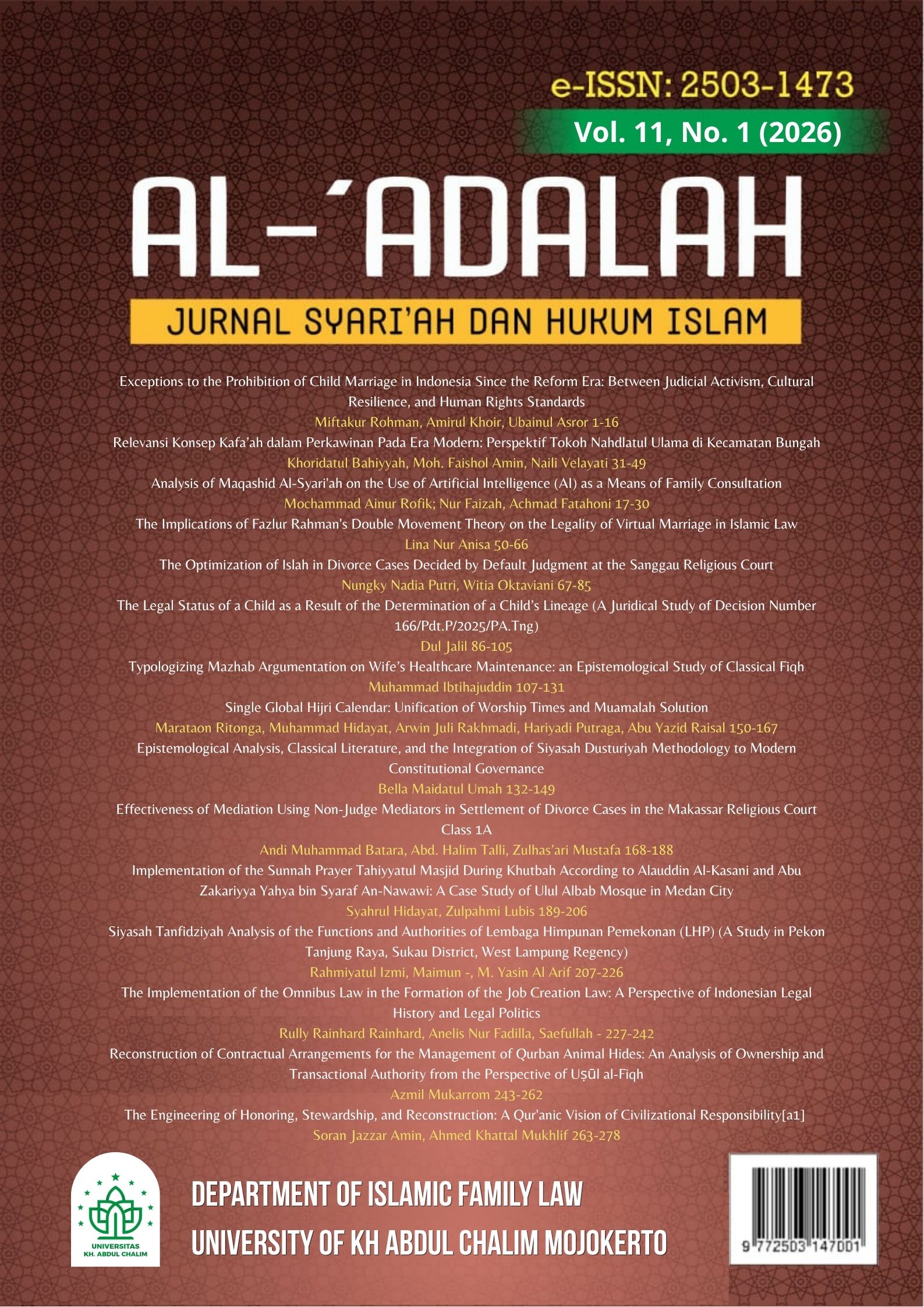 Syariah dan Hukum Islam
Vol 11 No 1 (2026)
Al-‘Adalah: Jurnal Syariah dan Hukum Islam, Vol. 11 No. 1 (2026), published on 13 July 2026, presents 15 research articles discussing various contemporary issues, including child marriage dispensations and human rights, the application of maqāṣid al-sharī‘ah to artificial intelligence in family consultation, the concept of kafā’ah in modern marriage, the legality of virtual marriage through Fazlur Rahman’s Double Movement theory, iṣlāḥ in divorce proceedings, the legal status and lineage of children, wives’ healthcare maintenance in classical Islamic jurisprudence, siyāsah dustūriyyah and modern constitutional governance, the Single Global Hijri Calendar, non-judge mediation in divorce cases, tahiyyatul masjid prayer during Friday sermons, village governance from the perspective of fiqh siyāsah, the Omnibus Law and Indonesian legal politics, contractual arrangements for qurban animal hides, and human stewardship of the earth through Qur’anic and maqāṣid perspectives. The issue involves authors from 2 countries (Indonesia and Iraq) and 6 Indonesian provinces, namely East Java, Banten, North Sumatra, South Sulawesi, Lampung, and West Java. The articles demonstrate strong alignment with the journal’s Focus and Scope, particularly Islamic family law, civil law, criminal law, constitutional law, Islamic economic law, and contemporary Islamic legal thought. The contributions also employ normative, empirical, socio-legal, comparative, and interdisciplinary approaches, reflecting the development of Islamic jurisprudence in response to contemporary legal, technological, social, and environmental challenges. Overall, the issue demonstrates strong consistency between its article titles, research themes, and the journal’s Focus and Scope.
-
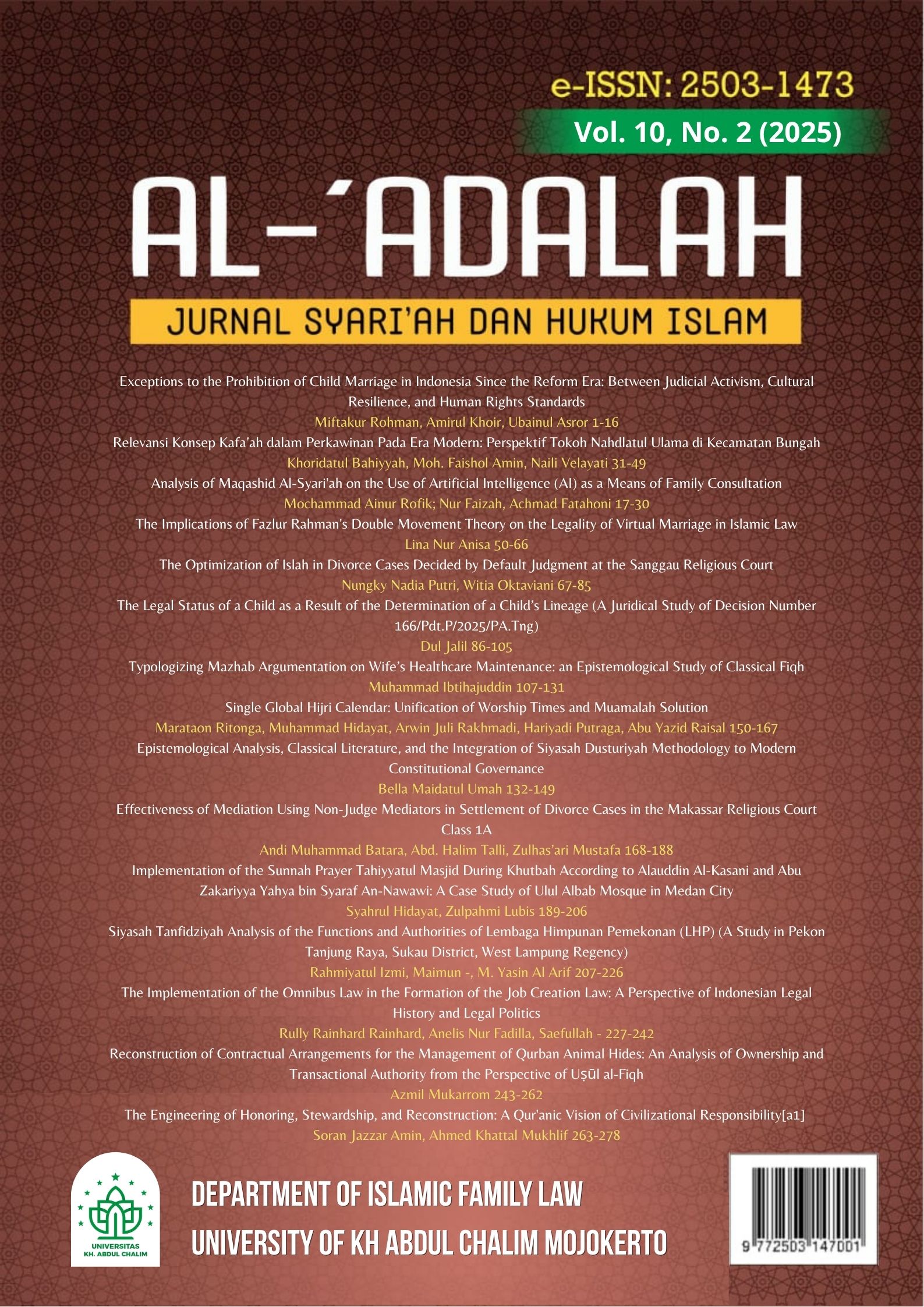 Syariah dan Hukum Islam
Vol 10 No 2 (2025)
Al-‘Adalah: Jurnal Syariah dan Hukum Islam, Vol. 10 No. 2 (2025), published on 5 December 2025, presents 15 research articles examining diverse issues, including the harmonization of Balinese customary and national divorce law, family harmony in the digital era, enforcement of Aceh’s Qanun Jinayah, parliamentary salaries from Islamic economic and maqāṣid perspectives, Bugis customary marriage dowry and land rights, productive waqf management, electoral regulations and political participation, the development of ḥifẓ al-bī’ah as a contemporary maqāṣid, mosque-based religious moderation, women's eligibility as marriage guardians, overseas marriages of Indonesian citizens, child protection, nikah sirri after engagement, and ethical challenges in Indonesian law enforcement. The issue involves authors from 1 country (Indonesia) and 7 provinces, namely DKI Jakarta, East Java, West Java, North Sumatra, Lampung, Banten, and West Kalimantan. The articles demonstrate strong alignment with the journal's Focus and Scope, particularly Islamic family law, civil law, criminal law, constitutional law, and Islamic economic law. They also incorporate socio-legal, empirical, comparative, and maqāṣid al-sharī‘ah approaches to address contemporary legal developments. Overall, the titles and research themes are highly consistent with the journal's Focus and Scope.
-
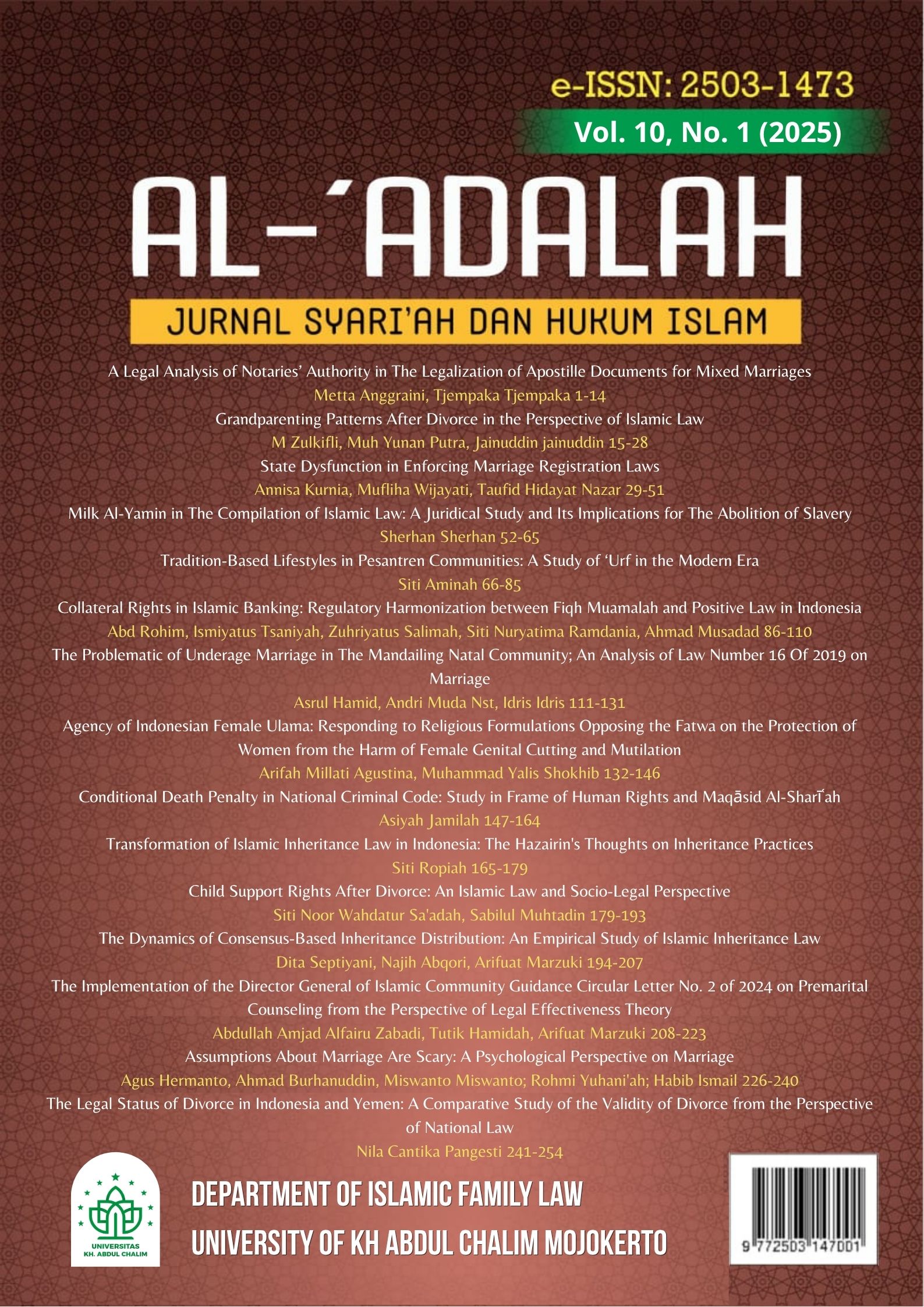 Syariah dan Hukum Islam
Vol 10 No 1 (2025)
Al-‘Adalah: Jurnal Syariah dan Hukum Islam, Vol. 10 No. 1 (2025), published on 15 June 2025, presents 15 research articles exploring diverse issues, including the legal authority of notaries in mixed-marriage apostille documents, grandparenting after divorce, state responsibility for marriage registration, milk al-yamin in Islamic law, customary practices in pesantren communities, collateral rights in Islamic banking, underage marriage, women's protection against female genital mutilation, conditional death penalties from human rights and maqāṣid al-sharī‘ah perspectives, Hazairin's contribution to inheritance reform, child maintenance after divorce, consensus-based inheritance distribution, the effectiveness of premarital counseling regulations, psychological perspectives on marriage, and comparative divorce law in Indonesia and Yemen. The issue involves authors from 1 country (Indonesia) and 7 provinces, namely DKI Jakarta, West Nusa Tenggara, Lampung, North Sumatra, East Java, West Java, and Central Java. The articles demonstrate strong alignment with the journal's Focus and Scope, particularly Islamic family law, civil law, criminal law, Islamic economic law, and contemporary developments in Islamic legal thought, while incorporating socio-legal, empirical, comparative, and interdisciplinary approaches.
-
 Syariah dan Hukum Islam
Vol 9 No 2 (2024)
Al-‘Adalah: Jurnal Syariah dan Hukum Islam, Vol. 9 No. 2 (2024), published on 13 December 2024, presents 10 research articles discussing issues such as marriage registration for indigenous religious communities, halal product marketing and consumer behavior, Islamic criminal law and land transactions, triple divorce, ta’aruf, Aceh’s Family Law Qanun, local traditions in Islamic legal construction, maqāṣid al-sharī‘ah, political fiqh, and consensual inheritance distribution (al-qismah al-riḍā’iyyah). The issue involves authors from 1 country (Indonesia) and 4 provinces, namely East Java, West Java, North Sumatra, and Central Java. The articles demonstrate good alignment with the journal’s Focus and Scope, particularly Islamic family law, civil law, criminal law, constitutional law, and Islamic economic law, while incorporating normative, empirical, socio-legal, and interdisciplinary approaches. Overall, the article titles and research themes are highly relevant to the journal’s Focus and Scope.
-
 Syariah dan Hukum Islam
Vol 9 No 1 (2024)
Al-‘Adalah: Jurnal Syariah dan Hukum Islam, Vol. 9 No. 1 (2024), published on 30 July 2024, presents 10 research articles discussing diverse issues, including marital maintenance (nafkah), cyber notary, Islamic astronomy and Asr prayer times, divorce factors, domestic violence and women's protection, children's rights in unregistered polygamous marriages, family law reform in Kuwait, public opinion on viral legal cases from a maqāṣid al-sharī‘ah perspective, social change and polygamy, and judicial decisions on nafkah iddah and mut‘ah. The issue involves authors from 1 country (Indonesia) and 5 provinces, namely East Java, the Special Region of Yogyakarta, West Java, West Sumatra, and South Sulawesi, based on the authors' institutional affiliations. The articles demonstrate strong alignment with the journal's Focus and Scope, particularly Islamic family law, civil law, criminal law, and Islamic legal studies, while incorporating normative, empirical, socio-legal, and interdisciplinary approaches. Overall, the article titles and research themes are highly relevant to the journal's Focus and Scope.
-
 Syariah dan Hukum Islam
Vol 8 No 2 (2023)
Al-‘Adalah: Jurnal Syariah dan Hukum Islam, Vol. 8 No. 2 (2023), published on 13 December 2023, presents 10 research articles discussing diverse issues, including marriage dispensation, cohabitation and criminal law reform, adopted children's inheritance rights, land dispute mediation, temporary cash waqf, sexual health in marriage and divorce, green economy from Qur'anic and Hadith perspectives, interfaith marriage, waqf management, and ikhtilat in prewedding culture. The issue involves authors from 2 countries (Indonesia and Malaysia) and 5 Indonesian provinces, namely the Special Region of Yogyakarta, DKI Jakarta, East Java, West Java, and the Riau Islands. The articles demonstrate strong alignment with the journal's Focus and Scope, particularly Islamic family law, civil law, criminal law, and Islamic economic and financial law, while incorporating maqāṣid al-sharī‘ah, socio-legal, comparative, and interdisciplinary approaches. Overall, the article titles and research themes are highly relevant to the journal's Focus and Scope.
-
 Syariah dan Hukum Islam
Vol 8 No 1 (2023)
Al-‘Adalah: Jurnal Syariah dan Hukum Islam, Vol. 8 No. 1 (2023), published on 28 June 2023, presents 10 research articles discussing diverse issues, including divorce in the postmodern era, premarital marriage guidance and prevention of early marriage, strategies for building lasting marriages, the concept of ḍarūrah in the four Islamic schools of law, customary marriage traditions in Nias, the eligibility of Islamic boarding school students as zakat recipients, multi-contract transactions from a maqāṣid al-sharī‘ah perspective, interfaith marriage and human rights, and wives as family breadwinners. The issue involves authors from 1 country (Indonesia) and 5 provinces, namely West Java, East Java, Banten, North Sumatra, and the Special Region of Yogyakarta. The articles demonstrate strong alignment with the journal’s Focus and Scope, particularly Islamic family law, civil law, Islamic economic and financial law, and Islamic legal methodology, while incorporating normative, empirical, sociological, and interdisciplinary approaches. Overall, the article titles and research themes are highly relevant to the journal’s Focus and Scope.




Al-'Adalah: Jurnal Syariah dan Hukum Islam by Department of Islamic Family Law University of Pesantren KH Abdul Chalim Mojokerto http://e-journal.uac.ac.id/index.php/adlh/index is licensed under a Creative Commons Attribution-ShareAlike 4.0 International License.